Aligning Incentives for Clinical Trials in the Age of AI
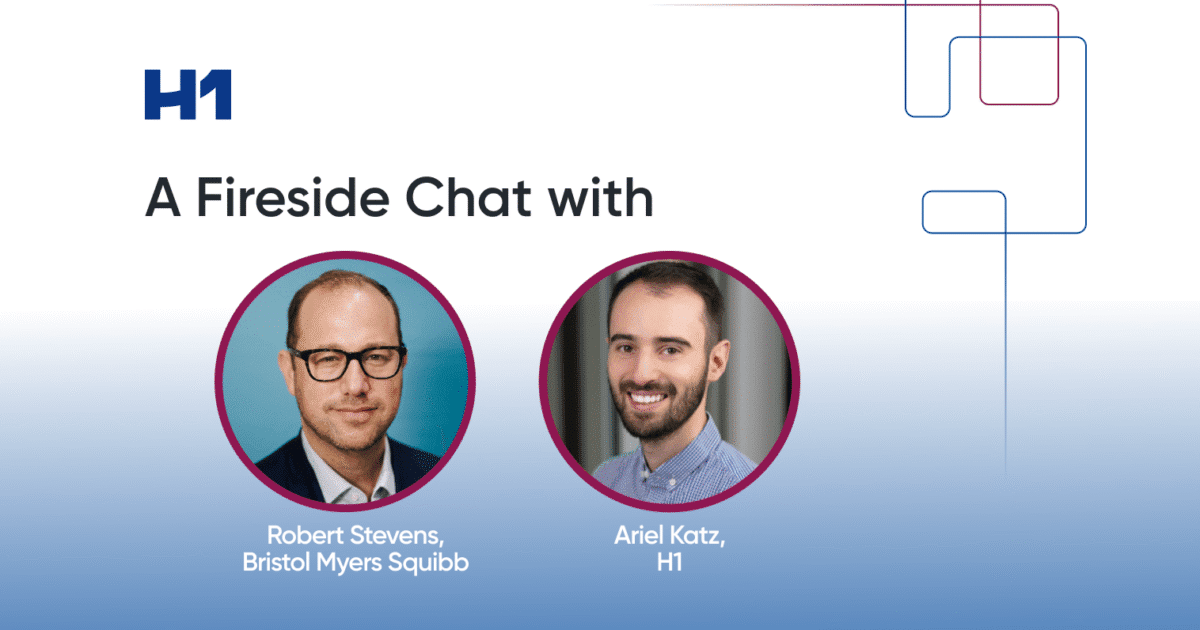
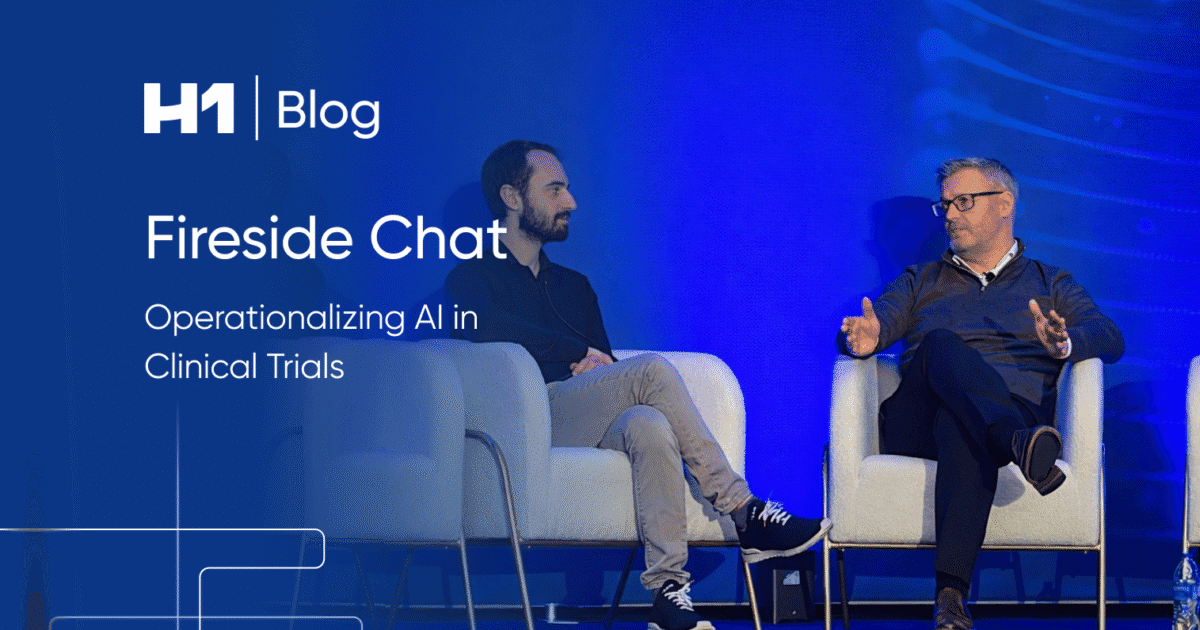
At SCOPE Summit US, Ariel Katz, CEO and Co-founder of H1, sat down with Robert Stevens, Head of Clinical Development Procurement at Bristol Myers Squibb, for a candid conversation about one of pharma’s most fundamental challenges: misaligned incentives between sponsors, CROs, and vendors are quietly undermining clinical trial efficiency, even as AI promises to transform the industry.
Their discussion revealed a stark disconnect: while the industry talks extensively about AI adoption, the underlying incentive structures haven’t evolved to support it. The result? Innovation stalls at the contract negotiation stage.
AI Adoption Starts with Mindset: From “Artificial” to “Augmented”
Before diving into incentive alignment, Stevens addressed the elephant in the room: getting teams comfortable with AI.
“What’s important with AI is that we’ve replaced the ‘A’ artificial for augmented,” Stevens explained. “Once you switch to augmented intelligence, people become more receptive to using it.”
At BMS, Stevens actively encourages his team to use generative AI to address complex problems, such as developing dynamic pricing models for clinical trial agreements that adjust based on disease area and enrollment barriers. “The more that people use it and get encouraged to use it, the more comfortable they get with it. The more organizations understand that it’s part of what we do.”
He draws a parallel to how we think about other tools: “ChatGPT is no different than someone who writes a book and has an editor. AI is being my editor.”
Evaluating AI: Looking for Frameworks, Not Just Features
When assessing AI capabilities in potential partners, Stevens takes a refreshingly practical approach. He’s incorporated AI as a formal evaluation criterion when working with CROs and vendors, but not in the way most companies claim to offer it.
“The number of companies I’ve met with that actually have a viable AI solution that’s legitimately AI is very, very small,” Stevens observed. “Most things are either pilots, concepts, or ideas.”
Rather than looking for companies claiming AI will “solve the world,” he evaluates their framework and receptivity to AI thinking. “What I’m looking for when we do those questions with suppliers is the framework and the receptivity of AI.”
It’s not about having the perfect AI solution today. It’s about demonstrating thoughtful problem-solving and openness to innovation.
The Incentive Misalignment Problem
The conversation turned to the core challenge: incentive structures in clinical trials are fundamentally broken, creating friction that undermines speed, quality, and innovation.
Stevens shared a telling example: “If you think about clinical trials, site agreements and groups that run those departments and manage those contracts, they’re incentivized by negotiating below a certain threshold. So if a cost per patient is $10,000 and they want to go up to $8,000, and they negotiate $7,500, that’s savings, and then you’re rewarded on how much you’re saving.”
The problem? “You talk to development heads, what you’ll find is they want to start their studies as quickly as possible and get sites up and rolling. So the misalignment of incentives becomes very problematic because on one hand, you have a function that is slowing down development where the end customer, development itself, wants to expedite.”
This dynamic plays out across clinical operations:
- Contract teams focused on cost savings
- Development teams focused on speed
- Sites holding more power and becoming selective about partnerships
- CROs switching project managers mid-study
“What’s the right incentive? It should be patient outcomes, right?” Stevens emphasized. But he added a pointed challenge:
"People often say to me that patients motivate them, the reason why they work in pharma is because of patients. And I always say, great. When’s the last time you volunteered at a hospital? And no one ever does."
A New Approach: Requests for Strategic Solutions
BMS has moved away from traditional RFPs focused on “rate times hours in what region” to something Stevens calls “Requests for Strategic Solutions.”
The premise is simple but powerful: “We have a problem that we want to solve. That problem is, how do we do more research at a lower cost? We may not have all the answers. We shouldn’t think we do, but we want to hear from you.”
This approach shifts the dynamic from transactional negotiations to true partnership, where vendors bring their cross-industry experience to solve sponsor challenges collaboratively.
Katz noted he’s seeing similar evolution from the most sophisticated sponsors:
"The ones that really understand the use cases start asking from first principles: Do they have patients that meet the I/E criteria? If so, can I spin up that site to make it possible to recruit patients? And are there capabilities that could be done there?"
Those sponsors are also building outcome-based metrics into their contracts, like requiring baseline improvements in diverse patient enrollment, with fee discounts if targets aren’t met.
The Shift to Outcome-Based Contracts
Both speakers agreed the industry needs to move toward outcome-based contracting, though Stevens acknowledged it’s still largely aspirational.
“I think contracts are changing dramatically,” he said. “There’s a shift that should be taking place where working with a company like H1 or a CRO or lab, they should become more outcome-based. We should be paying for outcomes.”
The challenge is defining what “outcomes” mean and factoring in variables outside a vendor’s control. Stevens’ recommendation: “Factor in what could go wrong into the outcome pricing. When you have a really transparent, open, partnership-based dialogue with a supplier, by putting everything on the table and understanding that yes, out of 100 site agreements, 15 to 20 may not go through, factor that into the pricing.”
Katz shared his own experience: a top 10 pharma company asked H1 to take on recruitment risk, saying they’d only pay if patients enrolled. “I said, that’s not in my control. I can’t tell you if you’re going to recruit them or not.”
The solution? H1 worked with two sophisticated sponsors to build diversity enrollment baselines into contracts, with quarterly reviews tracking progress. “It forced us to bring data to them every 90 days, and it actually forced us to work with their teams to track the data because we wouldn’t get paid if they didn’t track the data. That was really creative because it forced us to do the behaviors that their teams weren’t doing.”
Value-Based Procurement: Beyond Cost Savings
Stevens is championing a shift from pure cost savings to “value-based procurement,” a concept that challenges the traditional procurement playbook.
“If you’ve been in procurement long enough, you know it’s this yardstick every two, three years, right? Save me three percent, save me five percent. And companies are smart enough to know that’s the game to play. They’ve seen it before.”
The better approach? “What is the value you’re actually bringing? Where are you driving efficiencies and optimizing processes in ways that are measurable?”
This means having transparent conversations about what both parties actually need. Suppliers want to make money. Sponsors want to save money and get work done quickly. “The more transparent pharma could be with suppliers and vice versa,” the more successful partnerships become.
The AI Adoption Gap: Pharma is Falling Behind
Despite all the conference chatter about AI, Katz brought a sobering reality check: pharma is dramatically lagging other healthcare sectors in AI adoption.
“There was a report from one of our investors that went through AI adoption across healthcare,” Katz shared. “It looked at providers, health systems, payers, government, and pharma. We were the last. Pharma was by far the last, not even close. We were like an inch on the bar chart.”
The tangible impact? “If you think about how much has changed with AI in clinical trials, I don’t really know. Maybe regulatory, maybe document writing, maybe recommending sites. But your $100 million phase three study still costs $100 million, and you’re still paying a site $60,000 per oncology patient.”
Stevens agreed: “The industry talks a lot. The amount of chatter about AI is significant. But when you really look under the hood, has anyone really seen dramatic impact? Maybe you have. I just haven’t yet.”
Both acknowledged the industry is “heading in the right direction” but needs significantly more time. More importantly, it needs to operationalize AI rather than just pilot it.
The Path Forward: Transparency and Partnership
The most successful partnerships will be those where sponsors and vendors align around shared goals: faster trials, better patient outcomes, and measurable efficiencies.
Success requires moving beyond traditional procurement cycles focused solely on cost reduction. When sponsors and vendors have transparent conversations about shared challenges, define value through measurable outcomes, and build accountability into contracts, the industry can finally operationalize AI in ways that serve patients.
The tools and technology exist. What’s needed now is the courage to restructure incentives around what actually matters.
Ready to align your clinical trial partnerships around outcomes that matter? Request a demo to see how H1’s platform helps sponsors identify the right sites, investigators, and patients from first principles, enabling faster, more representative and successful trials.