Rethinking Clinical Trials: Why Data, Not Just AI, Will Define the Next Era
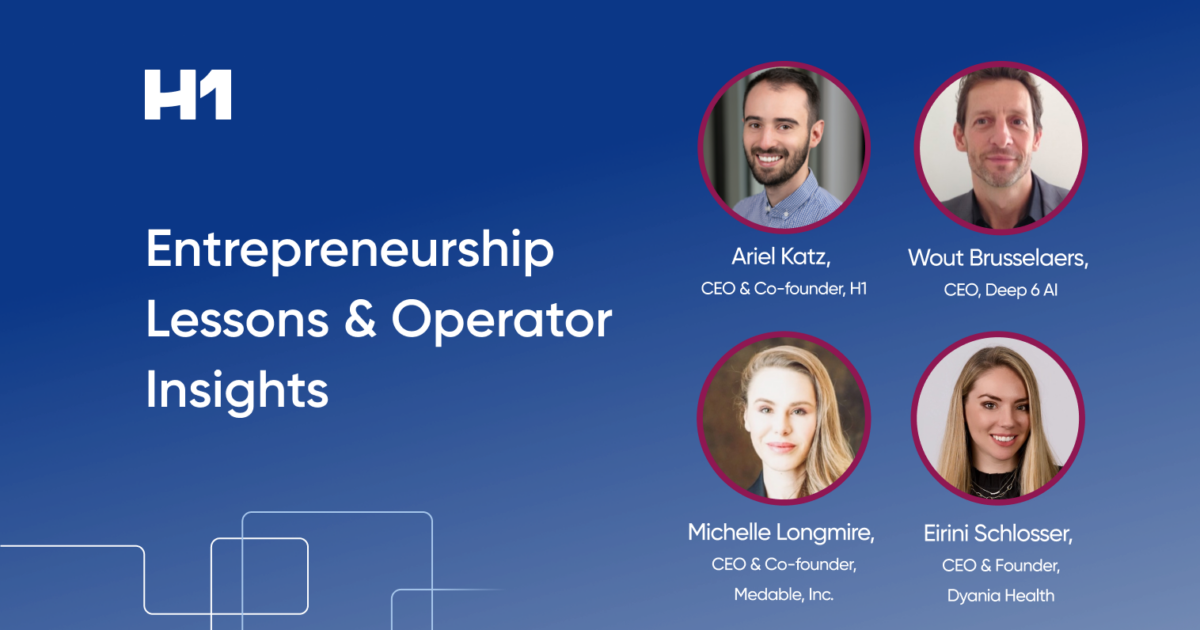
In a recent panel discussion on entrepreneurship and operator insights in clinical research, Mitesh Rao, MD, Founder and CEO of OMNY, moderated a candid conversation with four leaders building at the intersection of data, AI, and clinical trials:
- Wout Brusselaers, CEO of Deep 6 AI
- Ariel Katz, CEO and Co-Founder of H1
- Michelle Longmire, Co-Founder and CEO of Medable
- Eirini Schlosser, Founder and CEO of Dyania Health
At the center of the discussion was a tension the industry can no longer ignore. Everyone agrees clinical trials must become faster, more efficient, and more predictable. AI is advancing rapidly. Sponsors are rethinking long-standing workflows. And yet, global drug output has remained relatively flat while costs continue to climb.
The panel’s message was clear: the next phase of innovation in clinical trials will not be defined by who builds the flashiest AI interface. It will be defined by who owns, structures, and operationalizes the right data.
Build vs. Buy and the Platform Race
One of the most striking shifts described during the discussion was the renewed momentum behind building in-house.
“What we’ve seen over the past really one to two years is a big shift,” said Ariel Katz of H1. “They’re all building in-house now.”
For years, pharma companies leaned heavily on external vendors for technology. Today, many sponsors are reassessing that model. With generative AI tools more accessible than ever, internal teams believe they can assemble their own workflow layers for site selection, protocol design, and operational oversight.
“There’s a race to what is the end user interface for site selection and protocol design,” Katz noted.
That race reflects a broader reality. Sponsors are no longer satisfied with fragmented point solutions. They want cohesive environments that fit into their existing systems and decision-making processes. In many cases, that means building internal interfaces and layering external data into them.
But the panelists were pragmatic about what can and cannot be built internally. Workflow layers may be configurable. User interfaces can be redesigned. The harder question is what sits underneath.
Data is the Real Competitive Advantage
If everyone can assemble agents and interfaces, what actually differentiates solutions?

This theme surfaced repeatedly. While AI capabilities are advancing quickly, high-quality, longitudinal, and permissioned clinical data remains scarce and difficult to replicate.
“Anybody can build an agent,” Brusselaers said. “But getting access to data to really get the better agents, get the most of it, is pretty hard.”
The discussion moved beyond raw volume. It is not just about how much data exists, but how it is structured, validated, and contextualized. Clinical data is messy. Field names conflict. Records are incomplete. Real-world context is buried in notes and unstructured formats.
Schlosser emphasized how far the industry still has to go. “Training an AI model on raw data is akin to giving a physician a medical degree off of having them read three million medical records,” she said. Context and reasoning matter.
For companies like H1, which have invested in building structured profiles of clinical sites, investigators, and performance data over time, this shift reinforces a core principle. Even if sponsors choose to build their own interfaces, the underlying data layer remains foundational. Without structured and validated data, AI becomes a thin wrapper over unreliable inputs.
As AI becomes more commoditized, data becomes the moat.
Why Site-level Data Matters More Than Ever
If data is the differentiator, where does the most valuable data actually reside?
According to the panel, much of it lives inside health systems and clinical sites.
“The power is shifting to the sites because they have the data that is not easily accessible to others,” Brusselaers said.
Sponsors rely heavily on historical performance, enrollment projections, and feasibility responses when selecting sites. But as Katz pointed out, the visibility sponsors have into true site performance is limited.
“Who actually knows how well the sites are doing?” he asked. “It’s the sites.”
Sites understandably present their strongest case when responding to feasibility questionnaires. Benchmarking across institutions is difficult. Operational realities such as staffing constraints, competing trials, and patient pipeline variability are rarely transparent.
At the same time, health systems are increasingly protective of their data. There is fatigue around sharing information without clear value in return. Integration risks, compliance concerns, and limited internal resources all create friction.
This creates a structural challenge for the ecosystem. Sponsors want deeper visibility into site performance and patient availability. Sites want meaningful value exchange and workflow integration. Technology companies must navigate both. The companies that succeed will not simply aggregate public data. They will connect comprehensive site intelligence directly to their workflows.
Why Clinical Workflows Demand Specialized AI
The panel was unified on this point: healthcare is not a sandbox for experimental AI.
“This is not something you just throw a model at and hit go,” Schlosser said. Reasoning, validation, and medical specialization are essential.
Clinical trials operate in high-stakes environments governed by regulatory standards and patient safety requirements. Replacing or augmenting human decision-making in these settings demands more than prompt engineering.
Longmire drew an analogy to autonomous systems. Deploying AI in clinical operations is closer to building a self-driving car than deploying a chatbot. “These are systems that are working in a multifaceted environment where there’s reasoning required in a very high-stakes setting,” she explained.
This distinction matters. Many use cases in life sciences involve structured outputs that must be accurate, reproducible, and defensible under regulatory scrutiny. Training models requires domain-specific annotation, clinical expertise, and rigorous benchmarking against human performance.
If the benchmark is not human-level consensus, Schlosser warned, it is not sufficient for patient care.
For sponsors experimenting with internal builds, this is a critical reality check. Building an interface is one thing. Developing validated, specialized AI systems that can operate within good clinical practice standards is another.
The gap between general-purpose AI and clinical-grade AI remains significant. Bridging it requires both data depth and domain rigor.
Automating Clinical Operations with Agentic AI
While much of the conversation focused on foundational data and model rigor, the panel also highlighted where tangible operational gains are already emerging.
Clinical operations remain heavily manual. Monitoring sites often require navigating multiple legacy systems, reconciling data across platforms, and manually identifying issues.
Longmire described Medable’s approach as removing tactical burden from clinical research associates so they can focus on strategic oversight. “Our new product is designed to remove the tactical work of clinical operations and enable humans to be strategic,” she said.
Agentic AI systems can aggregate data across systems, surface actionable insights, and even execute low-risk tasks such as flagging missing data or triggering notifications.
Sponsors increasingly want these capabilities embedded into the tools they already use. They do not want to log into yet another platform. They want insights delivered directly into their workflow.
The broader opportunity is significant. As Longmire noted, 80 percent of clinical development budgets still go toward human labor. Despite advances in drug discovery, the operational machinery of trials has remained largely unchanged.
If AI can meaningfully reduce administrative overhead, improve monitoring efficiency, and optimize site engagement, the economics of clinical trials could shift dramatically.
But again, these systems are only as good as the data they reference. Agentic automation built on incomplete or outdated site intelligence will struggle to deliver consistent results.
The Foundation for the Next Generation of Clinical Trials
The panel closed with an undercurrent of cautious optimism. For the first time in years, sponsors are openly saying they are ready to rethink long-standing processes. Protocol handoffs, site selection models, and operational structures are all on the table.
The coming years will likely include noise. Some internal builds will fall short. Some AI claims will prove overstated. But the direction is clear. Clinical development cannot remain as manual and fragmented as it has been.
For organizations rethinking how trials are designed and executed, the question is not just what to build. It is what data to build it on.
To see how H1’s clinical data platform powers smarter site selection, feasibility, and trial planning with comprehensive site and investigator intelligence, Request a Demo.