How a Global Biopharma Company Improved Site Selection, Feasibility, and Trial Rescue with AI
Overview
A global biopharmaceutical company evaluated an AI-driven site selection and feasibility platform to improve how it identifies investigators, selects sites, and rescues underperforming trials.
The goal: move beyond fragmented, static datasets and legacy feasibility tools toward a more dynamic, patient-centric approach.
Key Use Cases and Results
There were four primary use cases where the platform delivered measurable impact across site selection, feasibility, and enrollment performance:
1. Expanding Site and Investigator Networks for New Trials
Challenge: Limited visibility into qualified investigators and sites across geographies.
Approach: Leveraged H1’s AI-driven site and patient intelligence to identify investigators and sites aligned to protocol-specific patient criteria.
Results:
- 175 qualified investigators matched to patient and eligibility requirements
- 150 high-fit sites identified across US and ex-US markets
- New geographic opportunities uncovered, including previously untapped regions
Impact: Enabled a shift from a known-site, historical approach to a data-driven, globally scalable site selection strategy, improving feasibility accuracy and expanding access to qualified patients.
2. Trial Rescue: Accelerating Enrollment
Challenge: Under-enrolling rare disease trial requiring rapid site expansion.
Approach: Used real-world patient data to identify high-potential investigators and sites based on actual patient availability, rather than historical trial participation alone.
Results:
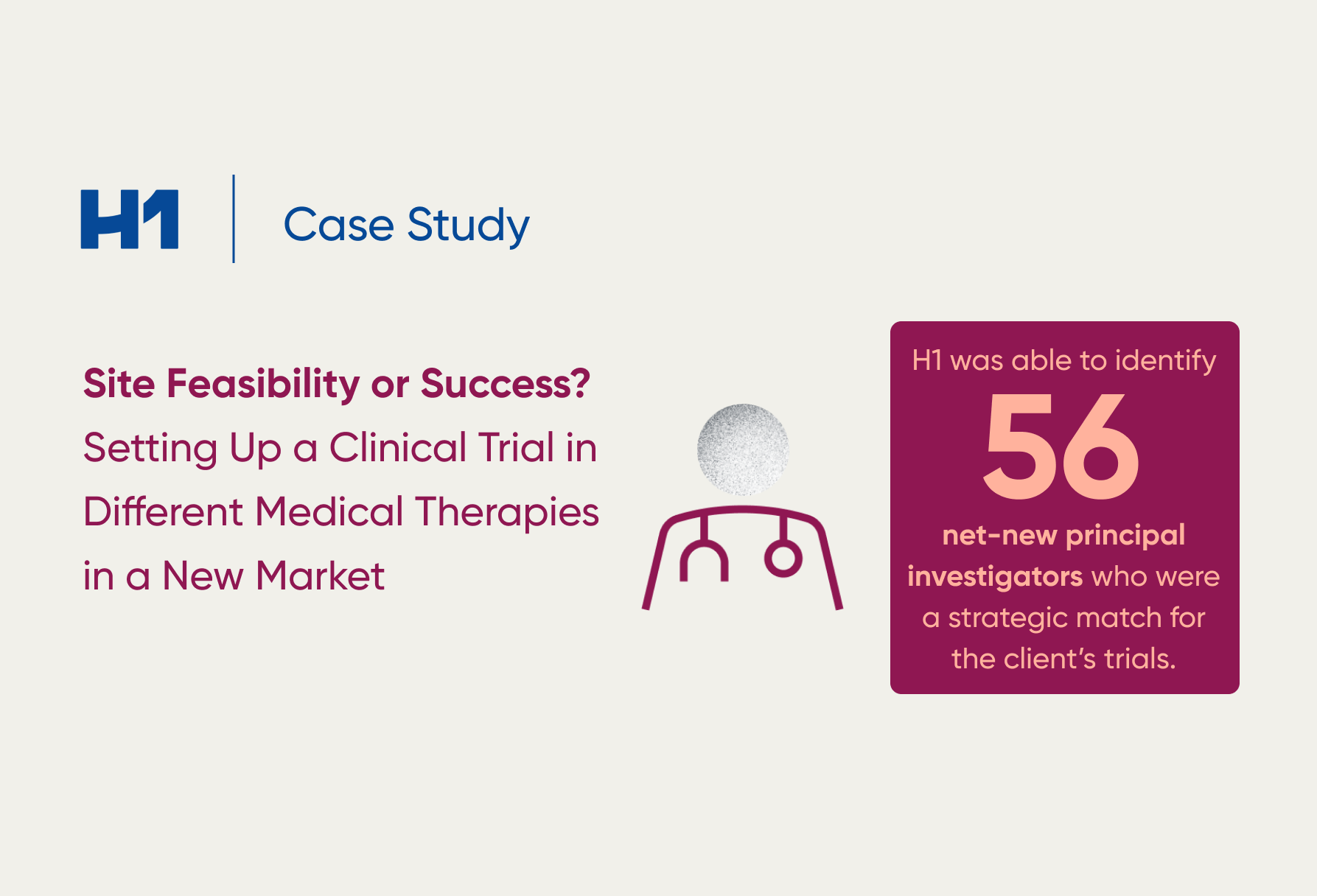
- 23 net-new sites identified with strong patient availability
- 8 high-value investigators surfaced at priority institutions
- Enabled immediate site outreach and contracting workflows
Impact: Enabled a targeted, data-driven trial rescue strategy, improving enrollment potential and reducing reliance on reactive site expansion.
3. Correcting Feasibility Misalignment
Challenge: Selected sites had zero eligible patients, creating risk for enrollment delays and poor patient representation.
Approach: Validated planned sites against real-world patient data prior to activation to ensure alignment with protocol-specific populations.
Results:
- Flagged sites with zero eligible patients early in the feasibility process
- Identified 42 net-new sites across 18 institutions with aligned patient populations
- Prioritized 7 high-value institutions for immediate outreach
Impact: Prevented costly feasibility misalignment by ensuring sites were selected based on actual patient availability, improving both enrollment potential and study representation from the outset.
4. Data Validation and Feasibility Benchmarking
Challenge: Limited ability to validate feasibility assumptions across multiple tumor types and indications.
Approach: Leveraged integrated data across investigators, patients, and historical trials to validate feasibility and benchmark against similar studies.
Results:
- 618 investigators identified with relevant patient populations and trial experience
- 200 aligned sites identified across multiple indications
- Benchmarked against 26 similar studies to inform feasibility strategy
Impact: Enabled granular, indication-level feasibility planning, improving trial design, site selection accuracy, and overall study execution timelines.
Why Sponsors Switch to H1 for Site Selection and Feasibility
Across trial planning, enrollment rescue, and feasibility validation, the sponsor found that H1’s AI-driven approach delivered measurable advantages over legacy tools, particularly in identifying net-new investigators and aligning sites to real patient populations.
Users consistently rated the platform highly for both effectiveness and usability (≥4/5), citing faster search workflows and access to site and investigator insights not available through other solutions. In practice, this translated into meaningful network expansion, with teams increasing their investigator pools by 10–15%+ and consistently identifying new, qualified investigators for every study.
Just as importantly, the platform improved confidence in feasibility decisions by enabling teams to identify investigators capable of enrolling representative patient populations—something traditional approaches often fail to validate early.